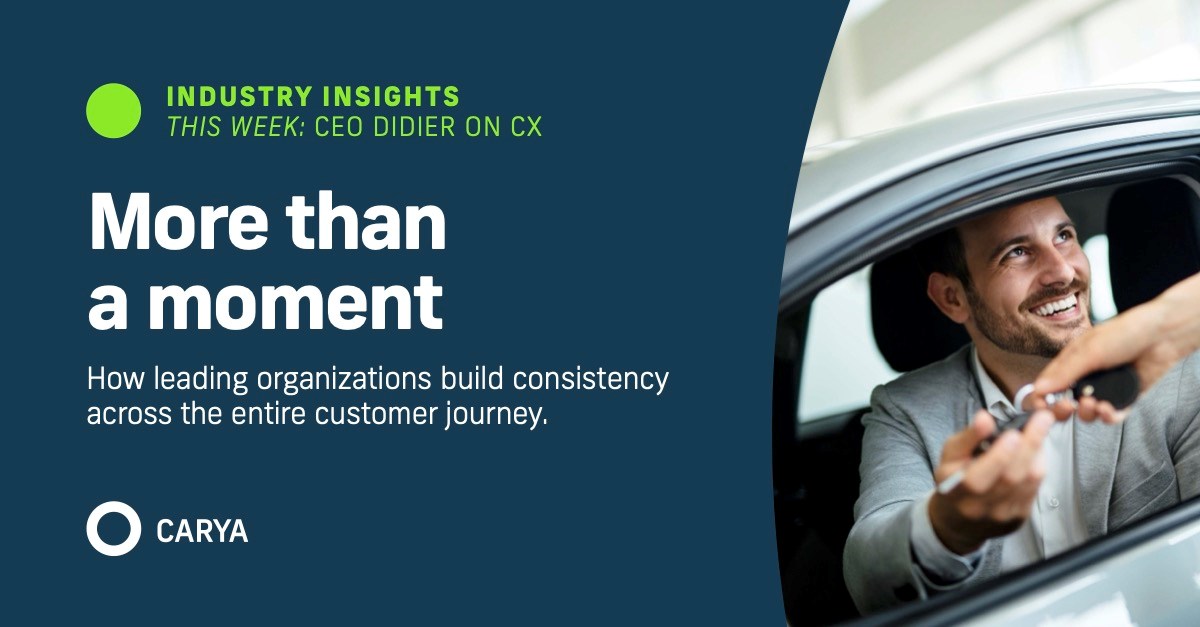
Customer experience is not a moment. It’s a system.
The automotive industry is evolving rapidly, and customer expectations are rising just as fast. Consumers expect seamless service, personal communication, and a consistent experience across every interaction.
Most dealer organizations are well aware of this shift. Significant investments are made in showroom experience, customer communication, and service quality. Yet despite these efforts, customer experience often remains inconsistent.
That is not a detail. In fact, it explains why many dealer organizations struggle to improve their KPIs. As discussed in our previous Industry Insight, KPIs are not the driver of performance, but the result of it. When customer experience is fragmented, the impact inevitably shows up in retention, conversion, and overall performance metrics.
According to Didier Passchier, CEO at CARYA, the problem is not a lack of ambition, but a lack of structure. “Many organizations try to improve customer experience by optimizing individual moments. But customers don’t experience isolated moments. They experience the consistency between them.”
From the customer’s perspective, there is no separation between departments. Sales, aftersales, marketing, and service are all part of the same relationship. Internally, however, these areas are often managed independently, with different systems, processes, and objectives.
This disconnect creates fragmentation. A customer may have a strong buying experience, but a less efficient service follow-up. Or a smooth service visit, followed by inconsistent communication afterwards. Each interaction may be acceptable on its own. But together, they fail to add up to a coherent experience.
That is where the real issue lies. Customer experience is often approached as an initiative, a project, or a series of improvements. But in reality, it is the outcome of how the entire organization operates. “Customer experience is not something you add, or an afterthought. It is something you must build into your processes,” Didier explains.
Leading dealer organizations understand this. They do not focus on optimizing individual touchpoints. Instead, they design end-to-end customer journeys, ensuring that every interaction is connected, consistent, and supported by the right data. It’s a complex ecosystem that requires alignment between systems, processes, and teams - with a shared understanding of the customer relationship across the business.
When that foundation is in place, customer experience becomes predictable and scalable. And that is where real differentiation happens.
In a market where products and pricing are increasingly similar, the ability to deliver a consistent and reliable customer experience becomes a key competitive advantage. Not with one perfect interaction, but with every interaction reinforcing the relationship - one touchpoint at a time.
Is your organization optimizing individual customer moments, or building a consistent customer experience across the entire journey?

That is not a detail. In fact, it explains why many dealer organizations struggle to improve their KPIs. As discussed in our previous Industry Insight, KPIs are not the driver of performance, but the result of it. When customer experience is fragmented, the impact inevitably shows up in retention, conversion, and overall performance metrics.
According to Didier Passchier, CEO at CARYA, the problem is not a lack of ambition, but a lack of structure. “Many organizations try to improve customer experience by optimizing individual moments. But customers don’t experience isolated moments. They experience the consistency between them.”
From the customer’s perspective, there is no separation between departments. Sales, aftersales, marketing, and service are all part of the same relationship. Internally, however, these areas are often managed independently, with different systems, processes, and objectives.
This disconnect creates fragmentation. A customer may have a strong buying experience, but a less efficient service follow-up. Or a smooth service visit, followed by inconsistent communication afterwards. Each interaction may be acceptable on its own. But together, they fail to add up to a coherent experience.
That is where the real issue lies. Customer experience is often approached as an initiative, a project, or a series of improvements. But in reality, it is the outcome of how the entire organization operates. “Customer experience is not something you add, or an afterthought. It is something you must build into your processes,” Didier explains.
Leading dealer organizations understand this. They do not focus on optimizing individual touchpoints. Instead, they design end-to-end customer journeys, ensuring that every interaction is connected, consistent, and supported by the right data. It’s a complex ecosystem that requires alignment between systems, processes, and teams - with a shared understanding of the customer relationship across the business.
When that foundation is in place, customer experience becomes predictable and scalable. And that is where real differentiation happens.
In a market where products and pricing are increasingly similar, the ability to deliver a consistent and reliable customer experience becomes a key competitive advantage. Not with one perfect interaction, but with every interaction reinforcing the relationship - one touchpoint at a time.
Is your organization optimizing individual customer moments, or building a consistent customer experience across the entire journey?

